Trip Report – Ripple Rock – 20 June 2016

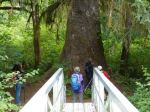
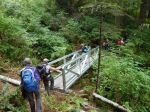
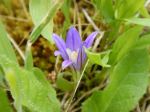
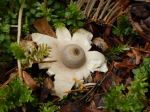
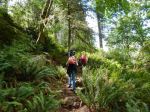
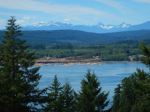
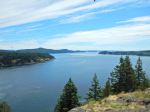
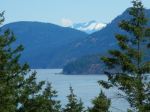
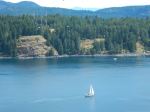
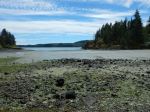
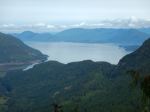
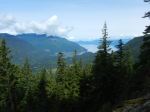
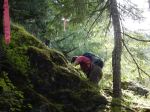
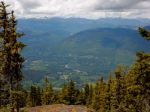
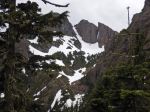
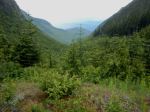
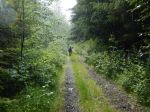
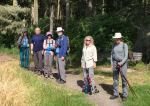
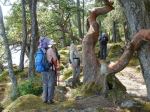
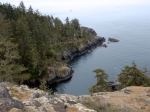
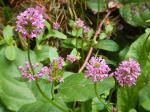
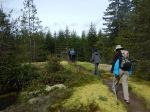
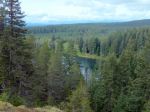
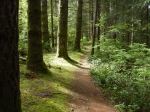
A beautiful day, perfect for hiking, 7 two-footed hikers and one very sanguine four-footed hiker took to the trail at 10 am. We stopped to admire the magnificent old-growth spruce at the start of the actual trail, certainly one of the largest, if not the largest, I have ever seen, even in Haida Gwaii. We encountered the first of the several metal bridges (and later, staircase) that have helped to change this trail designation from challenging to moderate. A pleasant walk through the lush forest, with one steep uphill, brought us to the first of several viewpoints. The view of the industry in Menzies Bay was not inspiring, but the exposed mud flats and eel grass were interesting, though we were too far away to see any particular wildlife. The trail continues around the bluff, offering occasional views south and east. A final stop at another viewpoint then the final staircase to the top of the bluff; the rock climb, up and down, pre-staircase, would have certainly been an interesting challenge. At the top we are treated to a perfect view of Seymour Narrows and the site of the former Ripple Rock. It was most interesting to see this historic site from the other side of the channel, most of us well familiar with the view from Maud Island on the Quadra side. We enjoyed almost an hour in the sunshine, having arrived at almost exactly slack, the Narrows were almost still. By the time we left, the boils and whirlpools of the rapidly increasing current were apparent, though only running then at about 4 knots, 1/3 of the way to the 12 knot max ebb that afternoon. On our return we passed several groups of hikers, presumably timing their hike to coincide with the max current. (I recommend we do the same for a return to Ripple Rock Trail, it would be well worth it.) We were back at the trailhead just after 2 pm. Flora of note were common camas still in flower at the first viewpoint and an earthstar beside the trail. An excellent hike, well worth repeating, even with the early morning start for some of us! 4 1/2 hours; 9.3 km.

Valerie
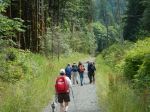
(click on photos to view larger)
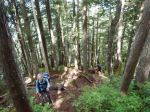
Hike – Ripple Rock – 20 June 2016

Trip Report – Kusam Klimb – 16 June 2016

There was some interest in doing the Kuskam Klimb trail (Mt. Hkusam, near Sayward, http://www.kuskamklimb.com) but we couldn’t find a date to fit everyone’s schedule, so the trip was postponed to possibly late summer or fall.

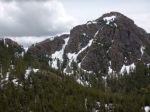
However the weather forecast and schedules aligned for four of us, so we made an impromptu decision to go check it out — just a reconnaissance, nothing serious — get to a viewpoint, check out the snow conditions, see what the trail is like. Well… they said it was steep, difficult, with some fixed ropes. It is that. Difficult on epic proportions. Bring your heart rate monitor! Poles help too, except they get in the way when using the ropes. Bring gloves for the ropes. There are a lot of ropes.

The trail starts very nicely, if it wasn’t steep it would be wheel chair accessible. That lasts about 2 km, up to 410 metre elevation. Then the trail divides. We took the shorter steeper trail. It’s more path than trail and it is steeper. Going up there are many short sections of fixed ropes, many more than we expected.

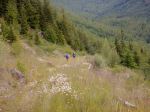
At 4.4 km, 970 m, the trail levels off very briefly and then it reverts to more climbing as it threads its way up what feels like must be a cliff. It’s all in the forest though, so except for a few peeks you don’t see how steep it is down to the valley. Oddly, there’s only one place on the trail where you feel any exposure. There were lots of alpine flowers and we watched a pair of woodpeckers feeding their noisy chicks in a hole in an old dead tree.

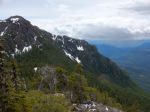
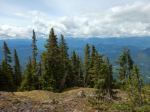
And on it goes, relentlessly up, until the Keta View Rock, at 5.8 km, 1270m, which has fabulous views. We took advantage of it for a lunch stop. This is where we thought about how slow it was coming up and how it might be even slower climbing back down and more dangerous. Since we were almost up to the elevation of the col we thought it might be faster and safer to continue up and over, since the south side had logging roads which would make it possible to go faster (although farther). Little did we know.

So, carrying on from there, the trail still goes up but at a reasonable trail grade. The forest opens up, almost sub-alpine, yellow cedars. All very nice. Except the recent days with thunderstorms dumped about 5 cm of hail above this elevation. We described it as white ball bearings. It made footing treacherous.

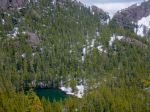
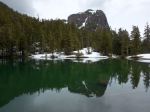
That section lasts until an excellent viewpoint of the mountain itself and the lake below at 6.8 km, 1435 m. Then we descended steeply in the slippery hail to a small lake which is a very nice green colour. 7.2 km, 1335 m.

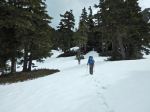
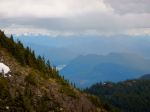
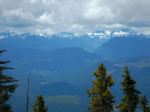
From the lake up to the col there is a snow patch and we kicked steps in the snow. Ours were the only tracks. The col is the high point on the trail, 7.9 km, 1469 m, with good views to the south.

From now on it’s all downhill. The first kilometre is very steep downhill, with long fixed ropes, still on slippery hail. Eventually the ropes and hail end. There is a wonderful lush green spring at 9.2 km, 1130 m, and we continued on a normal grade trail, winding down through old growth forest.

At 9.8 km, 1045 m, the trail crosses the stream on a log bridge and becomes an old logging road, wider and flatter, surrounded by young alders. Classic bear country. We didn’t see any bears but we saw lots of bear signs, some quite fresh. This is where it started to sprinkle and looking back the mountain was in the clouds. The weather forecast for good weather was right, but it did warn of showers developing late in the day.

The road down Stowe Creek Valley is a very pleasant walk, with nice view of the surrounding mountains and valleys. The only problem is that after a hard day it goes on forever. It feels endless.

After a couple hours (16.9 km, 380 m) we took the turnoff from this good logging road to a more ancient one which heads back to the start of the Klimb. The forest in this section isn’t so interesting, not if you’re tired. Eventually we made it back to the car. 24.4 km, 11 3/4 hours.

We did this hike two days before the real Kuskam Klimb event for 2016. We did not envy the runners who would be trying to go fast on this route! The runner times are online and simply amazing. They range from 2 hours (!!!!!) to 12 hours. As a hike, the Kusam Klimb trail is very interesting and certainly challenging, but it’s very long to do in one day.

Norris

trail guide
http://kusamklimb.com/trail-guide.php

trail map
http://saywardfutures.ca/wp-content/updloads/2015/11/MountHKusamTrail.pdf


(click on photos to view larger)
Trip Report – Sooke – 16-18 May 2016

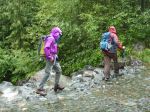
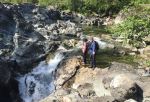
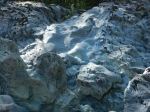
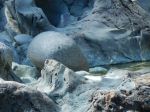
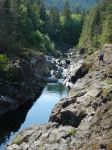
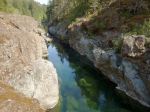
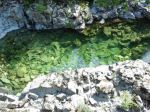
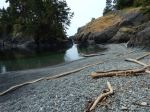
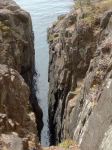
We began our trip to Sooke by visiting the Sooke Potholes. Eight of us drove up to the Regional Park and spent a few hours walking to the viewpoints and beaches, admiring the channels and sculpted rocks. 5.3 km.

We camped at the Sooke River Campground, which was well located for us and very quiet. We had wonderful appies and socializing each night. There were quite a lot of birds, including quail, rabbits and at least one bear in the area.

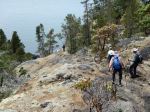
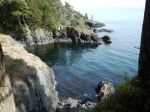
On Tuesday, seven of us hiked the Coast Trial in the East Sooke Regional Park. After the car shuffle, we started at Aylard Farm and hiked west to Pike Road Trail. The views along the rugged coast and across the Juan de Fuca to the Olympic Peninsula were spectacular. We really enjoyed the arbutus trees, which were continuous along the exposed bluffs and the excellent wildflowers in spite of the dry conditions. The route, undulating over the many rocky points and bluffs, was quite challenging. Just under 7 hours; 14.7 km.

On Wednesday, several people headed home, while four of us had an easy walk at Whiffen Spit and Sooke Harbour House. We then went separate ways, with some biking on the Galloping Goose trail to Matheson Lake; hiking up to Babbington Hill in East Sooke Regional Park; and visiting the Sooke Museum. It was too windy for kayaking. There were lots more destinations we couldn’t begin to visit in two and a half days.

Debbie

Here is a list of flowers:
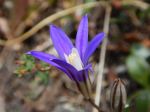
harvest brodiaea
death camas
yarrow
smooth alumroot (heuchera)
white rhododendron
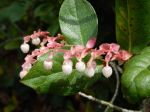
evergreen huckleberry
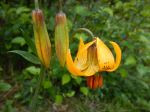
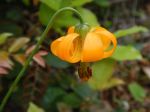
tiger lily
nootka rose
red paintbrush
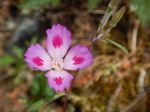
sea blush
field chickweed
red columbine
nodding onion
fool’s onion (brodiaea)
fireweed
starflower
orange honeysuckle
farewell-to-spring
wild strawberry
broad-leaved stonecrop
false lily-of-the-valley
small-leaved montia
Siberian miner’s lettuce (candy flower)
white-flowered hawkweed
narrow-leaved hawkweed
arbutus
salal
manzanita


(click on photos to view larger)
Hiking – Sooke – 16-18 May 2016

Trip Report – Snowden Demonstration Forest – 27 Apr 2016

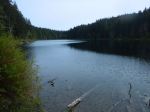
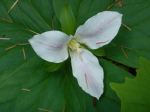
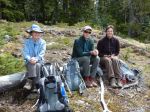
Five members explored the trails in the Snowden Demonstration Forest. Because the road over the dam is closed due to of construction, the access is via Duncan Bay Road (access map available at Outdoor Addictions), but the roads are good. We parked at the Lost Lake parking area and hiked around Lost Lake. We stopped for a snack on the eastern viewpoint and had lunch at the western viewpoint. The forest has quite an open understory, and there were trillium and other early wildflowers. The trails and routes we used were named Mudhoney Pass, Sanitarium, Scotty’s, T’aint, Riley Lake, and Tri Mac. The trail map is available at the Outdoor Addictions store or online at https://gocampbellriver.com/files/MapsForDownload/Snowden_Forest_Trail_Map.pdf

The trails range from flat grades that used to be logging railroad lines to walks along moss covered rocky ridges. We didn’t see anyone else while we walked. It was a very enjoyable walk, and it barely scratched the surface of what is available there. 7.6 km, 3.5 hours.

Norris

(click on photos to view larger)
Hiking – Snowden Demonstration Forest – 27 Apr 2016

Hiking – Sooke – 16-18 May 2016

Activity Hiking
Destination Sooke
Date 16-18 May, Monday-Wednesday
Trip Coordinator Debbie Quigg
Contact Info debbie.quigg@ualberta.ca or 3710; please contact the coordinator by May 1.
Description We will spend three days (two nights) in Sooke. The suggested accommodation will be camping at the Sooke River Campground. They also have three rustic cabins for rent. We have reserved three tent sites.  Please contact the coordinator about these.  If you want an RV site or a cabin, please make the arrangements yourself (250-642-6076).
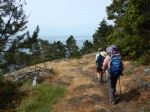
The primary hiking destinations will be the Coast Trail in East Sooke Regional Park, the Sooke Potholes, or other trails in the area. There is also the opportunity to bike along the Galloping Goose trail, or kayak in the harbour.

Meeting Place Sooke River Campground; 2259 Phillips Rd, Sooke
Departure Time na
Difficulty The Coast Trail is challenging. The walk along the Potholes is easy.
Cost Transportation and camping ($25/night/tent or $40 or $60/night for the cabins)
Trip limits none
Dogs? Possible, but challenging
Notes: This is a very historical area on Vancouver Island. Recommended reading: West Coast Pioneer – John Muir