Trip Report – Ripple Rock – 20 June 2016

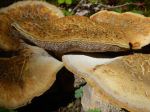
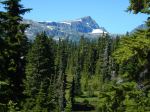
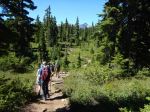
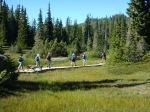
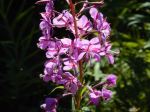
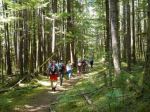
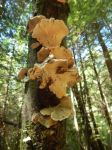
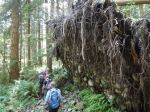
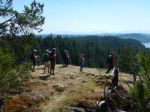
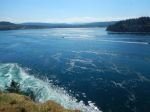
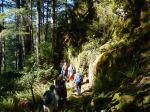
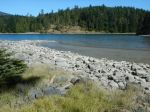
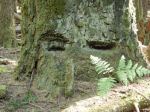
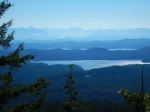
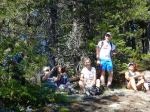
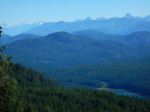
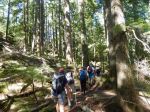
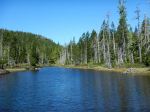
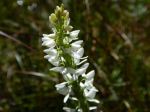
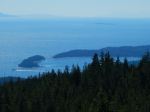
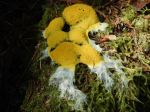
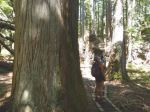
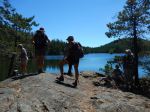
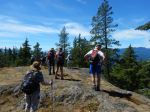
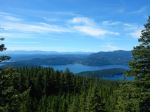
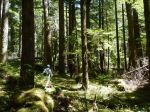
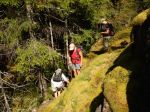
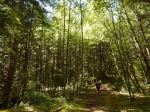
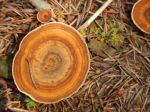
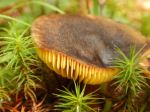
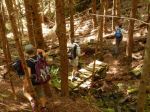
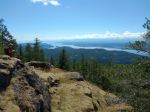
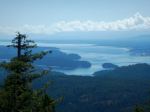
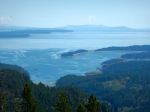
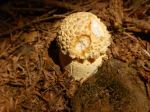
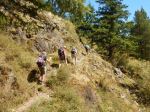
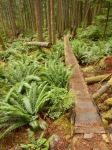
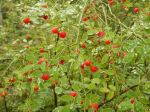
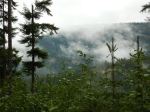
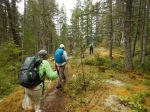
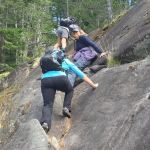
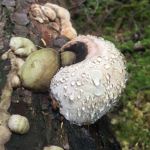
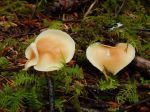
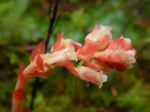
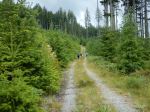
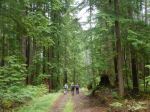
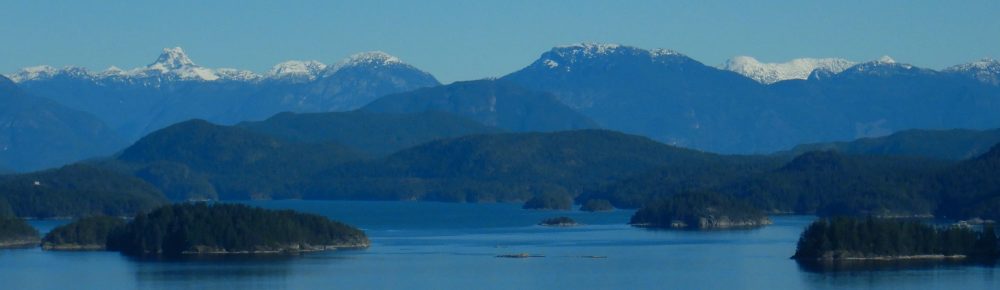
A beautiful day, perfect for hiking, 7 two-footed hikers and one very sanguine four-footed hiker took to the trail at 10 am. We stopped to admire the magnificent old-growth spruce at the start of the actual trail, certainly one of the largest, if not the largest, I have ever seen, even in Haida Gwaii. We encountered the first of the several metal bridges (and later, staircase) that have helped to change this trail designation from challenging to moderate. A pleasant walk through the lush forest, with one steep uphill, brought us to the first of several viewpoints. The view of the industry in Menzies Bay was not inspiring, but the exposed mud flats and eel grass were interesting, though we were too far away to see any particular wildlife. The trail continues around the bluff, offering occasional views south and east. A final stop at another viewpoint then the final staircase to the top of the bluff; the rock climb, up and down, pre-staircase, would have certainly been an interesting challenge. At the top we are treated to a perfect view of Seymour Narrows and the site of the former Ripple Rock. It was most interesting to see this historic site from the other side of the channel, most of us well familiar with the view from Maud Island on the Quadra side. We enjoyed almost an hour in the sunshine, having arrived at almost exactly slack, the Narrows were almost still. By the time we left, the boils and whirlpools of the rapidly increasing current were apparent, though only running then at about 4 knots, 1/3 of the way to the 12 knot max ebb that afternoon. On our return we passed several groups of hikers, presumably timing their hike to coincide with the max current. (I recommend we do the same for a return to Ripple Rock Trail, it would be well worth it.) We were back at the trailhead just after 2 pm. Flora of note were common camas still in flower at the first viewpoint and an earthstar beside the trail. An excellent hike, well worth repeating, even with the early morning start for some of us! 4 1/2 hours; 9.3 km.

Valerie

(click on photos to view larger)

Hike – Ripple Rock – 20 June 2016

Trip Report – Kusam Klimb – 16 June 2016

There was some interest in doing the Kuskam Klimb trail (Mt. Hkusam, near Sayward, http://www.kuskamklimb.com) but we couldn’t find a date to fit everyone’s schedule, so the trip was postponed to possibly late summer or fall.

However the weather forecast and schedules aligned for four of us, so we made an impromptu decision to go check it out — just a reconnaissance, nothing serious — get to a viewpoint, check out the snow conditions, see what the trail is like. Well… they said it was steep, difficult, with some fixed ropes. It is that. Difficult on epic proportions. Bring your heart rate monitor! Poles help too, except they get in the way when using the ropes. Bring gloves for the ropes. There are a lot of ropes.

The trail starts very nicely, if it wasn’t steep it would be wheel chair accessible. That lasts about 2 km, up to 410 metre elevation. Then the trail divides. We took the shorter steeper trail. It’s more path than trail and it is steeper. Going up there are many short sections of fixed ropes, many more than we expected.

At 4.4 km, 970 m, the trail levels off very briefly and then it reverts to more climbing as it threads its way up what feels like must be a cliff. It’s all in the forest though, so except for a few peeks you don’t see how steep it is down to the valley. Oddly, there’s only one place on the trail where you feel any exposure. There were lots of alpine flowers and we watched a pair of woodpeckers feeding their noisy chicks in a hole in an old dead tree.

And on it goes, relentlessly up, until the Keta View Rock, at 5.8 km, 1270m, which has fabulous views. We took advantage of it for a lunch stop. This is where we thought about how slow it was coming up and how it might be even slower climbing back down and more dangerous. Since we were almost up to the elevation of the col we thought it might be faster and safer to continue up and over, since the south side had logging roads which would make it possible to go faster (although farther). Little did we know.

So, carrying on from there, the trail still goes up but at a reasonable trail grade. The forest opens up, almost sub-alpine, yellow cedars. All very nice. Except the recent days with thunderstorms dumped about 5 cm of hail above this elevation. We described it as white ball bearings. It made footing treacherous.

That section lasts until an excellent viewpoint of the mountain itself and the lake below at 6.8 km, 1435 m. Then we descended steeply in the slippery hail to a small lake which is a very nice green colour. 7.2 km, 1335 m.

From the lake up to the col there is a snow patch and we kicked steps in the snow. Ours were the only tracks. The col is the high point on the trail, 7.9 km, 1469 m, with good views to the south.

From now on it’s all downhill. The first kilometre is very steep downhill, with long fixed ropes, still on slippery hail. Eventually the ropes and hail end. There is a wonderful lush green spring at 9.2 km, 1130 m, and we continued on a normal grade trail, winding down through old growth forest.

At 9.8 km, 1045 m, the trail crosses the stream on a log bridge and becomes an old logging road, wider and flatter, surrounded by young alders. Classic bear country. We didn’t see any bears but we saw lots of bear signs, some quite fresh. This is where it started to sprinkle and looking back the mountain was in the clouds. The weather forecast for good weather was right, but it did warn of showers developing late in the day.

The road down Stowe Creek Valley is a very pleasant walk, with nice view of the surrounding mountains and valleys. The only problem is that after a hard day it goes on forever. It feels endless.

After a couple hours (16.9 km, 380 m) we took the turnoff from this good logging road to a more ancient one which heads back to the start of the Klimb. The forest in this section isn’t so interesting, not if you’re tired. Eventually we made it back to the car. 24.4 km, 11 3/4 hours.

We did this hike two days before the real Kuskam Klimb event for 2016. We did not envy the runners who would be trying to go fast on this route! The runner times are online and simply amazing. They range from 2 hours (!!!!!) to 12 hours. As a hike, the Kusam Klimb trail is very interesting and certainly challenging, but it’s very long to do in one day.

Norris

trail guide
http://kusamklimb.com/trail-guide.php

trail map
http://saywardfutures.ca/wp-content/updloads/2015/11/MountHKusamTrail.pdf


(click on photos to view larger)

Trip Report – Mine Lake Bluff – 15 June 2016

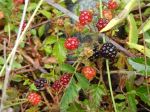
In spite of the downpour between 7:00 and 8:00, six of us decided to go on this hike and were rewarded by clearing skies. We hiked the trail from the Surge Narrows road into Homewood’s Woodsman camp, stopping along the way at viewpoints of Mine Lake and to sample the salmonberries and huckleberries. We followed the steep trail to the bluff and then out on to the somewhat exposed rock before arriving at great views at the top of the bluff. I highly recommend that this trip only be undertaken when the rock is dry, but I don’t always follow my own advice. We browsed around the bluff enjoying the views in different directions, sighting two fawns, a red-tailed hawk and a nighthawk, before stopping for lunch.

After lunch we descended by a less travelled route, down a gully to the north, which then traverses under the cliffs and circles back to the trail up to the bluff. We stopped by Mine Lake to enjoy the sun and the view of the quiet lake. 5.9 km; 3 1/2 hours.

Debbie

(click on photos to view larger)

Hike – Mine Lake Bluff – 15 June 2016

Trip Report – Open Bay – 6 June 2016

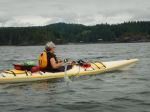
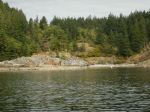
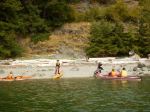
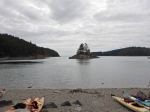
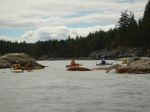
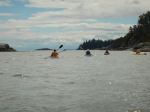
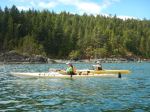
Our paddle on Monday, June 6, started from a new launch site for most of us, the end of Breton Road in Open Bay; a short downhill, a short walk avoiding the nettles, a few logs and the inevitable rocks though not as big nor as steep as at the more commonly used Valdez beach launch site. Five of us were on the water by 10:30 am. The overcast soon dissipated and the weather quickly turned from warm to hot, northwest winds gusted to about 20 knots throughout the day.

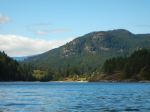
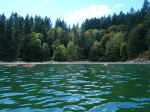
We paddled east along Open Bay shores, admiring the contorted and dramatic geology, peered into one cave, then turned north into Moulds’ Bay. The rapidly dropping tide prevented us from taking the shortcuts so we paddled through Shellaligan Pass into Hoskyn Channel, past the north Breton, then into Village Bay. The snow-dappled peaks of the Coast and Vancouver Island mountain ranges provided dramatic backdrops to the north and west.

Our lunch stop, after one and a half hours of paddling was Village Bay beach where we noted the new signage posted by the We Wai Kai nation, as this is Reserve land. The very low tide revealed eel grass and its many inhabitants and the rich marine life in the intertidal zone.

After a short lunch break we were boosted on our return by a following sea pushed by the north-west winds and the flooding tide. We stayed in Hoskyn due to the very low tide, and turned west to Open Bay on the north side of the southernmost Breton. Here we stopped to admire the seals laying on their backs on rocks just above the tideline, apparently sunning their bellies. We also saw many oystercatchers and a flock of wood ducks as well as several herons, gulls, and eagles.

As we came into Breton Beach we could see sea urchins, pencil stars and bat stars on the rocks below. The very low tide meant a long haul up the rocky beach, the usual challenge of launching from Open Bay. We were off the water by about 2:45 pm after a hot but very pleasant paddle.

Valerie

(click on photos to view larger)

Kayaking – Open Bay – 6 June 2016

Trip Report – Surge Narrows Trail – 1 June 2016

Six of us enjoyed our hike along the Surge Narrows trail. We stopped at the first viewpoint to watch the tidal rapids (8.8 knot flood tide at 11:00), then walked the route trail and shoreline through Raven Bay. We had good views of starfish and urchins. After lunch on the rocky point the tide was still low enough to go to a small island for views up Okisollo Channel.

Julie

(click on photos to view larger)

Hike – Surge Narrows Trail – 1 June 2016

Trip Report – Stramberg Old Growth – 25 May 2016

Four hikers and one dog enjoyed a lovely spring hike, beginning at the south end of Vic’s marsh where we were fortified by ripe salmonberries. We stopped for a look at the old barn built by Vic Balatti. The building is still sturdy but several square-timbered floor and ceiling joists have been removed. The trail winds along the marsh through open Douglas fir forest with occasional old growth fir. Past the end of the marsh the trail passes through stands of moss-covered alder, hemlock and back into mature fir.   Several old growth cedar are lying on the ground where they were cut sometime in the past and left for some reason. One large solitary Western white pine was noted along the trail. We stopped for lunch in a grove of old growth fir, then proceeded on a short distance to the main stand of old fir trees. One giant clearly stood out in the crowd, a massive, stovepipe-straight beauty that was worth the hike all by itself.

The north half of the trail is less used but well-marked with flagging tape. Sections of the trail at this end could be improved by a chainsaw and clippers where downed trees make going slow. On the way back, we stopped off for a snack at the bluff overlooking the lake at the north end of the marsh. By mid-afternoon, the day was warming up so a cool Northwest breeze was welcome.   Hiking time was a bit more than 5 hours moving at a good pace, and including lunch and a snack break (13.2 km).   Highlights were the old fir trees, of course, but also the wide variety of plant communities we hiked through.

Janis

(click on photos to view larger)

Hike – Stramberg Old Growth – 25 May 2016

Trip Report – Sooke – 16-18 May 2016

We began our trip to Sooke by visiting the Sooke Potholes. Eight of us drove up to the Regional Park and spent a few hours walking to the viewpoints and beaches, admiring the channels and sculpted rocks. 5.3 km.

We camped at the Sooke River Campground, which was well located for us and very quiet. We had wonderful appies and socializing each night. There were quite a lot of birds, including quail, rabbits and at least one bear in the area.

On Tuesday, seven of us hiked the Coast Trial in the East Sooke Regional Park. After the car shuffle, we started at Aylard Farm and hiked west to Pike Road Trail. The views along the rugged coast and across the Juan de Fuca to the Olympic Peninsula were spectacular. We really enjoyed the arbutus trees, which were continuous along the exposed bluffs and the excellent wildflowers in spite of the dry conditions. The route, undulating over the many rocky points and bluffs, was quite challenging. Just under 7 hours; 14.7 km.

On Wednesday, several people headed home, while four of us had an easy walk at Whiffen Spit and Sooke Harbour House. We then went separate ways, with some biking on the Galloping Goose trail to Matheson Lake; hiking up to Babbington Hill in East Sooke Regional Park; and visiting the Sooke Museum. It was too windy for kayaking. There were lots more destinations we couldn’t begin to visit in two and a half days.

Debbie

Here is a list of flowers:
harvest brodiaea
death camas
yarrow
smooth alumroot (heuchera)
white rhododendron
evergreen huckleberry
tiger lily
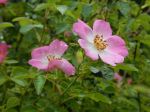
nootka rose
red paintbrush
sea blush
field chickweed
red columbine
nodding onion
fool’s onion (brodiaea)
fireweed
starflower
orange honeysuckle
farewell-to-spring
wild strawberry
broad-leaved stonecrop
false lily-of-the-valley
small-leaved montia
Siberian miner’s lettuce (candy flower)
white-flowered hawkweed
narrow-leaved hawkweed
arbutus
salal
manzanita


(click on photos to view larger)

Hiking – Sooke – 16-18 May 2016

Trip Report – Around Mt. Seymour – 13 May 2016

Five of us hiked from the Nugedzi trail head, up the old logging road north of Beech’s Mountain, along the old logging road that runs on the west side of the Nugedzi plateau, up a trail to a viewpoint of Nugedzi Lake, then down along a flagged route and trail to connect up with another old logging road which continues below the west and north sides of Mount Seymour and then descends, ending in a recently logged area just south of the gravel pit. The old logging roads can be very nice for walking, covered by a carpet of moss when they are level. The steep ones can be rough walking though.

The west side of the Nugedzi plateau features a number of small lakes or ponds. The north side of Seymour features some nice views to the north.

The trip was 14.4 km and took 5.5 hours, not including the car shuffle.

Norris

(click on photos to view larger)

Hike – Mt. Seymour logging roads – 13 May 2016

Trip Report – Gowlland Harbour – 2 May 2016

Thirteen members left Gowlland Harbour Resort on a bright, sunny, calm day for a tour around North and South Gowlland Harbour. Many thanks to resort manager Carmen for allowing us to launch there. We paddled north first toward the log dump and sorting area. There was a lone buck on one of the islands and two otters playing on a dock for entertainment. Some members had not realized how much activity goes on in the log sort. We then paddled to the old shipwreck off May Island and had lunch on the island. The snow-capped peaks of Strathcona Park were stunning against the blue sky.

Next we went to Vigilant Island and watched many seals playing. From here we traveled down the east side of Gowlland Island to the narrow opening into April Point Bay. A few of us tried our skills in the current and found it can be hard in cross current. A word of caution to anyone that does not know this area, the current is not always running the same way as it is outside in Discovery Passage and can be quite fast.

We then paddled around the south end of Gowlland Harbour and up by Stag and Fawn Island. The Sea Blush bloom was early this year, but some flowers were still to be seen. We arrived back at launch site about four hours and 6.5 nautical miles after having left. All and all, it was a stunning day.

Les

Note:  Special thanks from all of the participants to Les for the delicious prawns, smoked salmon, cheese and wine contribution to our picnic lunch.

Here is the bird list for the day:

Horned Grebe
Glaucous-winged Gull
Bonaparte’s Gull
California Gull
Double-crested Cormorant
Pelagic Cormorant
Great Blue Heron
Canada Goose
Mallard Duck
Bufflehead
Common Merganser
Pigeon Guillemot
Marbled Murrelet
Bald Eagle
Belted Kingfisher
Northwest Crow
Common Raven
Pacific Wren
American Robin
Spotted Towee
Townsend’s Warbler

(click on photos to view larger)
Kayak – Gowlland Harbour – 2 May 2016

Trip Report – Snowden Demonstration Forest – 27 Apr 2016

Five members explored the trails in the Snowden Demonstration Forest. Because the road over the dam is closed due to of construction, the access is via Duncan Bay Road (access map available at Outdoor Addictions), but the roads are good. We parked at the Lost Lake parking area and hiked around Lost Lake. We stopped for a snack on the eastern viewpoint and had lunch at the western viewpoint. The forest has quite an open understory, and there were trillium and other early wildflowers. The trails and routes we used were named Mudhoney Pass, Sanitarium, Scotty’s, T’aint, Riley Lake, and Tri Mac. The trail map is available at the Outdoor Addictions store or online at https://gocampbellriver.com/files/MapsForDownload/Snowden_Forest_Trail_Map.pdf

The trails range from flat grades that used to be logging railroad lines to walks along moss covered rocky ridges. We didn’t see anyone else while we walked. It was a very enjoyable walk, and it barely scratched the surface of what is available there. 7.6 km, 3.5 hours.

Norris

(click on photos to view larger)
Hiking – Snowden Demonstration Forest – 27 Apr 2016